

The US CLARITY Act: A Pivotal Moment for the Crypto Industry
The crypto industry and investors are closely watching the progress of the US CLARITY Act, a legislative effort that has faced delays due to political gridlock and concerns from industry stakeholders. This bill aims to redefine the regulatory landscape for digital assets, determining which federal agency will oversee them and how decentralized finance (DeFi) will be governed.
Currently, the US Senate is working on finalizing the details of the CLARITY Act, with significant disagreements emerging between Democrats and Republicans. One of the main points of contention is the inclusion of ethics provisions and a ban on government bailouts for the crypto industry. While Democrats have pushed for these elements, Republicans have strongly opposed them.
The crypto sector itself has raised concerns about specific provisions in the bill. For instance, Coinbase, the largest cryptocurrency exchange in the United States, has expressed opposition to clauses that would prevent it from offering stablecoin yields. Meanwhile, the banking lobby argues that such yields could jeopardize deposit stability and the broader financial system.
Evolution of the CLARITY Act
May 2025: Introduction of the CLARITY Act
On May 29, 2025, House Committee on Financial Services Chairman French Hill introduced the CLARITY Act. According to the committee, the bill aimed to establish clear and functional requirements for digital asset market participants, emphasizing consumer protection while encouraging innovation.
The introduction came at a time when digital assets were seen as the next step in financial innovation, and the current regulatory framework was perceived as stifling growth.
June-July 2025: House Passage of the Bill
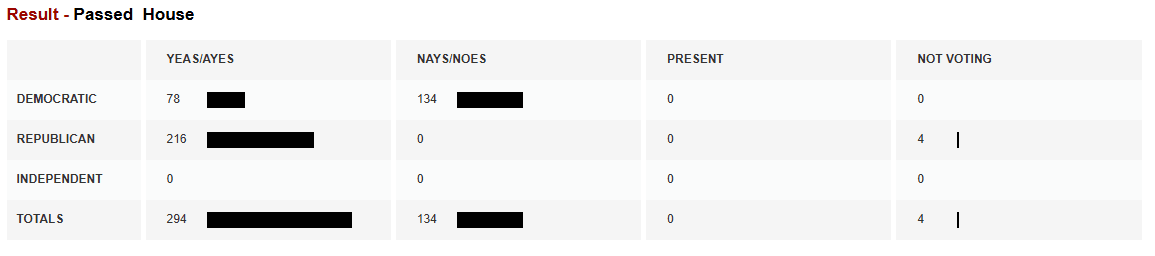
The House of Representatives moved swiftly on the CLARITY Act. By June 23, the bill was placed on the calendar for a vote. On July 17, the House passed the bill with a vote of 294-134. The majority of support came from Republicans, with 216 voting in favor and none opposing. However, there was some bipartisan support, with 78 Democrats joining the “Yea” vote.
July-September 2025: Senate Begins Work
Following the House’s passage, the bill moved to the Senate, where it quickly became a focal point of debate. On July 22, Republican leaders on the Senate Banking Committee released a draft version of the bill, aiming to establish clear distinctions between digital asset securities and commodities.
Senate Banking Committee Chair Tim Scott expressed optimism about the Senate moving forward at a similar pace as the House, setting an initial deadline of September 30, 2025.
October-December 2025: Disagreements and Government Shutdown
As the Senate worked on the bill, tensions arose over its provisions. Senator Elizabeth Warren, a known skeptic of cryptocurrencies, criticized the tax treatment of digital assets, arguing that it could provide an unfair advantage over traditional financial products.
Meanwhile, the Senate Agricultural Committee released its own discussion draft, highlighting ongoing debates over which federal agency—Commodity Futures Trading Commission (CFTC) or Securities Exchange Commission (SEC)—would regulate the industry.
The US federal government shutdown from October 1 to November 12 further complicated progress, ultimately ending after a small group of Senate Democrats voted with Republicans to fund the government temporarily.
December 2025-January 2026: Markup Session and Industry Pushback
Senator Cynthia Lummis had initially predicted that the CLARITY Act would reach President Trump’s desk by New Year’s Eve. However, as the year drew to a close, this seemed increasingly unlikely.
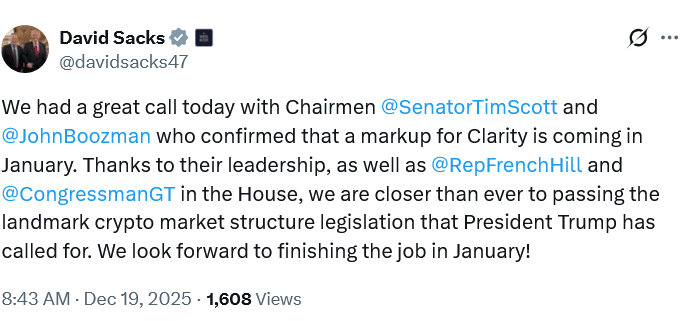
On December 19, the White House’s crypto and AI czar, David Sacks, announced that a markup session would take place in January. However, the planned session was postponed due to substantive disagreements between the crypto industry and the banking sector.
Coinbase CEO Brian Armstrong voiced strong opposition to the bill, citing provisions that banned interest-bearing stablecoins and positioned the SEC as the primary regulator for the crypto industry. Other financial leaders, including Goldman Sachs CEO David Solomon, echoed these concerns, stating that the bill needed significant revisions.
Despite these challenges, work on the law continued. The Senate Agriculture Committee announced its own markup session on January 27, with Democratic members attempting to introduce amendments, including an ethics provision banning Congress from trading crypto and ruling out any possibility of a government bailout.
These amendments failed along party lines, allowing the Republican majority to advance the bill to the Senate floor.
February 2026: High-Level Talks and Political Maneuvers
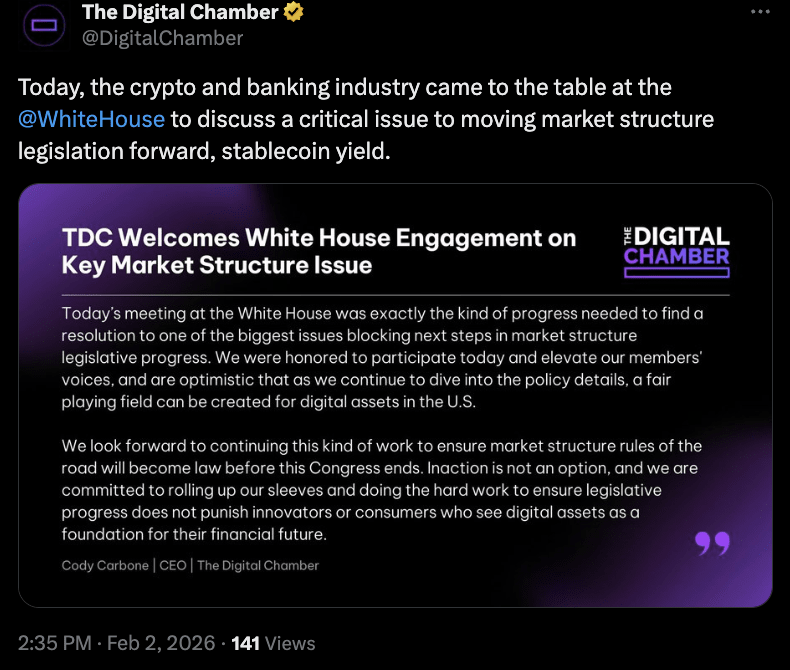
In February 2026, crypto industry executives, lawmakers, and bankers met frequently at the White House and in Congress to resolve their differences. The Digital Chamber of Commerce reported that a meeting on February 3 focused on stablecoin yields.
Executives, including Ripple chief legal officer Stuart Alderoty, described these discussions as “productive.” However, no final deal has been reached yet. Delays have reportedly caused nearly $1 billion in outflows from the crypto market, according to data from CoinShares.
Some analysts believe the delays could ultimately benefit the industry, providing more time to negotiate favorable terms. Market analyst Michaël van de Poppe noted that if the bill were approved in its current form, it could have a negative impact on the market.
With the midterm elections approaching, the crypto lobby is actively building its political influence through donations to political action committees (PACs). Both Republican and Democratic members of Congress are eager to pass legislation that favors the industry before the 2026 campaign cycle begins.
The success of the CLARITY Act now hinges on a race against time, as all parties continue to navigate the complex landscape of crypto regulation.