
Key Takeaways
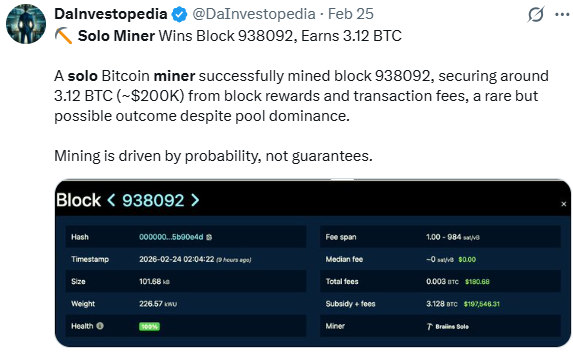
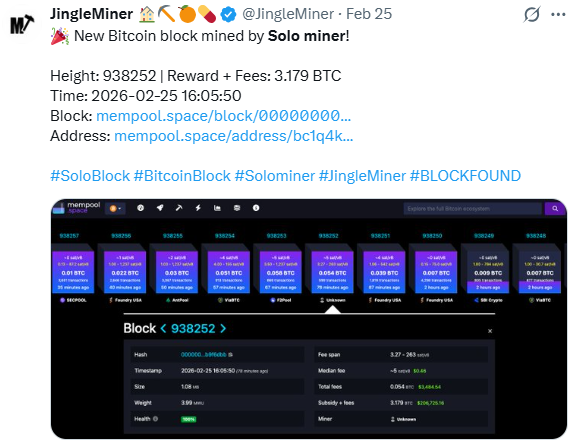
In January and February, individual miners successfully mined full Bitcoin blocks worth over $200,000-$300,000 each, without sharing rewards with a pool.
Over the past year, only about 22 blocks out of over 52,000 were mined solo, representing roughly 0.04% of total blocks.
With a hashrate of around 1 ZH/s and difficulty above 125 trillion, small miners face astronomical odds.
Solo mining remains technically possible, but economically it is rare, unpredictable, and accounts for less than 1% of total network output.
In January and February 2026, Two Solo Bitcoin Miners Stunned the Crypto World
On Jan. 13, a single address mined a full Bitcoin block and earned 3.125 BTC plus fees, nearly $300,000 at the time. There was no mining pool. No shared payout. One miner received everything.
Then, on Feb. 11, another solo participant mined Block #936100, earning 3.153 BTC, including 0.028 BTC in fees, worth roughly $213,000. According to AtlasPool, the miner temporarily rented 450 petahashes per second (PH/s) for about 90 minutes.
The odds of success? Just 0.4485%.
A few days later, another operator reportedly rented 1 PH/s for around $75 and landed a block worth about $200,000.
Stories like these spread quickly because they reinforce a powerful idea: that anyone can still strike digital gold.
Technically, that’s true. Statistically? It’s a very different story.
Is Solo Bitcoin Mining Still Worth It in 2026?
To answer that, we need to zoom out.
Bitcoin produces about 144 blocks per day, or more than 52,000 blocks per year. According to solo mining tracker data, individual miners collectively found just 22 blocks over the past 12 months.
That represents:
0.04% of total annual blocks.
Meaning 99.96% of blocks were mined by pools.
Roughly 1 out of every 2,400 blocks was solo mined.
In other words, solo wins are real, but they are statistical outliers. They make headlines precisely because they are rare.
The Core Reason Comes Down to Math
Inside the Math: Real Chances of Mining a Bitcoin Block
Bitcoin mining is a probability game. Miners compete to solve cryptographic puzzles. The more computing power (hashrate) a miner controls relative to the total network, the higher their chances of winning the next block.
As of 2026, Bitcoin’s network hashrate is hovering near 1 zetahash per second (1 ZH/s), which is 1,000 exahashes, or 1,000,000 terahashes.
Let’s put that in perspective:
If a miner runs a small 6 TH/s machine at home:
His share of the network is microscopic.
His chance per block attempt is about 1 in 170 million.
What is the expected time to mine a block? Over 3,000 years.
Running nonstop for a year gives about a 0.03% chance.
That’s similar to lottery-level odds. The difference? A lottery ticket costs a few dollars.
Mining requires:
Expensive hardware
Constant electricity
Maintenance and cooling
Ongoing operational costs
Bitcoin mining follows what’s called a Poisson process, meaning wins are random and unpredictable. Someone eventually gets lucky. But the system doesn’t guarantee fairness or timing. Probability doesn’t care how long you’ve been trying.
Bitcoin Hashrate Near 1 ZH/s: Why Solo Wins Were So Unlikely
The difficulty of mining adjusts automatically to keep blocks coming every 10 minutes.
In 2026:
Network hashrate: 1 ZH/s
Mining difficulty: above 125 trillion
Block reward: 3.125 BTC (after 2024 halving)
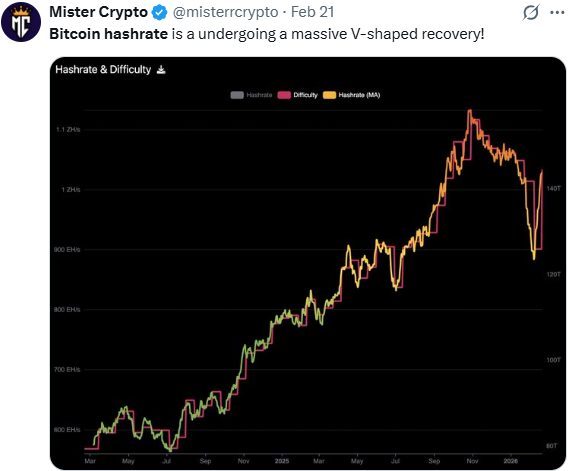
As hashrate rises, difficulty rises too. That means:
More machines compete
More energy is consumed
* Each block becomes harder to win
When a solo miner succeeds today, they are competing against:
Publicly listed mining companies
Industrial-scale farms
Operations with thousands of ASIC machines
Energy contracts negotiated at massive scale
The 450 PH/s rented miner on Feb. 11 had a 0.4485% chance, still less than half of 1%. Even that “high” probability required enormous temporary computing power.
Solo Mining vs Mining Pools: Risk, Rewards, and Reality
Most miners join pools instead of mining solo. Here’s why.
Solo Mining:
Winner takes entire block reward
Extremely high variance
Long periods of zero income
Lottery-style outcome
Mining Pool:
Share rewards proportionally
Predictable daily payouts
Much lower variance
Sustainable income model
Think of it like this: solo mining is buying one giant lottery ticket. Pool mining is earning small, steady payments based on the miner’s contribution.
Over time, pools dominate because they reduce financial risk. That’s why pooled operations mine more than 99% of blocks.
What Transaction Count and Probability Really Show
Examining solo wins, transaction counts, and probabilities reveals how rare each event truly was.
A block with over 4,000 transactions suggests heavy network usage and higher fee income. A block with fewer than 2,000 transactions indicates lighter activity.
Probability shows how unlikely each win was based on the miner’s hashrate versus the global network.
In 2025, solo miners’ daily win probabilities ranged from:
1 in 800
To 1 in 6,875,000
In some cases, equivalent to once every 10,000-18,000 years statistically.
Not all solo wins are equal. Some had stronger setups. Others were near-impossible flukes.
But collectively, they remain rare.
Why Some Bitcoin Miners Are Pivoting to AI
Meanwhile, some large mining firms are shifting toward AI infrastructure. Why?
Mining rewards halve every four years. Energy costs are rising. Bitcoin price volatility impacts revenue. AI data centers offer steadier margins.
Even publicly listed miners have begun reallocating capital toward high-performance computing (HPC) and AI workloads.
This shift highlights an important truth: mining economics are tight, even at scale. If industrial players are diversifying, that says something about long-term margins.
What These Rare Solo Wins Really Mean
So what do these solo successes tell?
They show:
Bitcoin remains technically open to anyone
Luck can still beat scale, occasionally
* Decentralization is alive in principle
But they also show:
The network is dominated by industrial capital
Difficulty is near historic highs
Solo mining remains under 1% of total blocks historically
Most participants rely on pooled or cloud-based infrastructure
Solo mining in 2026 is best understood as:
Ideological participation
Entertainment
* A high-variance gamble
It is not a reliable income strategy.
Bitcoin Mining Is No Longer A Small-Town Gold Rush
It is a capital-intensive global industry competing at nearly 1 zetahash per second.
Yes, lightning still strikes.
But history shows solo wins remain below 1% of total blocks, often closer to 0.04%. The headlines celebrate the miracle. The math explains the reality.
And in 2026, that reality is clear: solo mining is possible. Profitable, sustainable solo mining is extraordinarily rare.