
Bitcoin Faces Extended Decline Amid Market Volatility
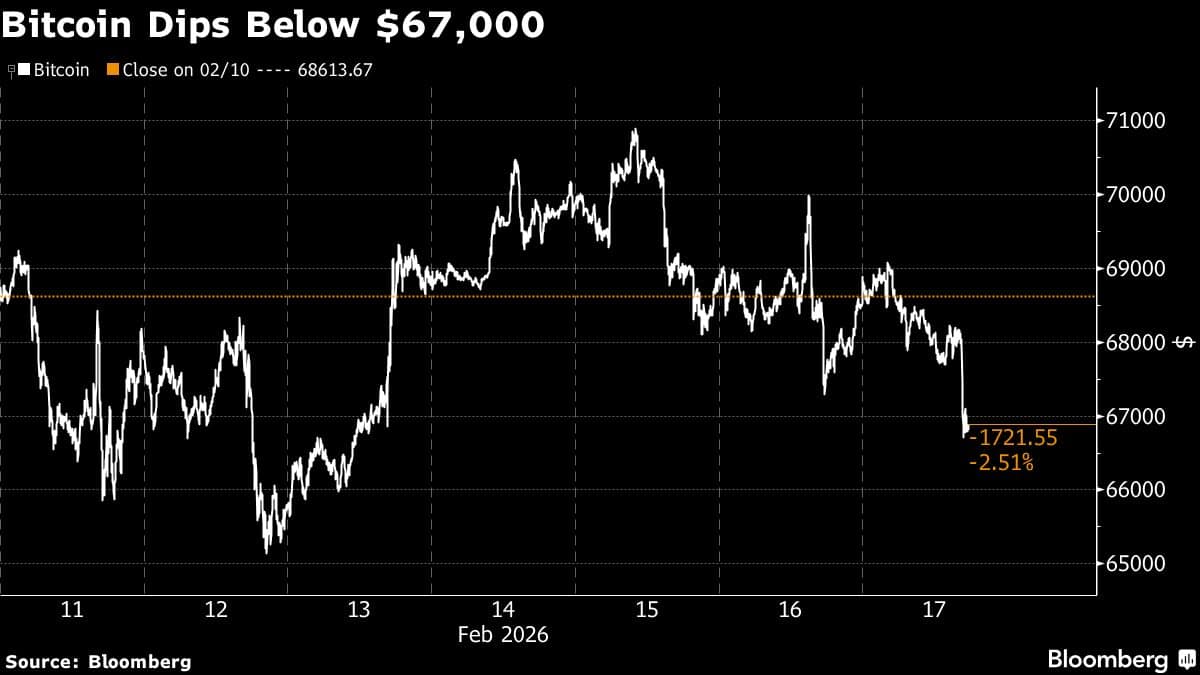
Bitcoin experienced a four-week decline as broader market volatility continued to impact investor sentiment. The cryptocurrency dropped as much as 3.2% to $66,604 on Tuesday in New York before partially recovering. This movement mirrored earlier declines in US equities, although Bitcoin failed to keep up with the slight upward trend in stock markets.
Noelle Acheson, author of the Crypto is Macro Now newsletter, noted that sentiment in crypto markets remains bleak. While there has been significant progress in institutional adoption, this development is not reflected in current prices, further dampening overall sentiment.
The uncertainty surrounding artificial intelligence (AI) has contributed to market volatility on Wall Street. Traders are struggling to gauge the potential impact of AI on various sectors of the economy, and there is skepticism about whether the substantial investments in AI will yield immediate returns.
Flows continue to be a challenge for Bitcoin, with $360 million withdrawn from US-listed exchange-traded funds last week. This marks the fourth consecutive week of net outflows, indicating ongoing concerns among investors.
CryptoQuant’s Fear and Greed Index reached 10 out of 100 on Monday, signaling extreme fear in the market. Paul Howard, senior director at market maker Wincent, anticipates consolidation as Bitcoin seeks new sources of positive sentiment. He suggested that a US Supreme Court ruling on tariffs, due on Friday, could have more influence than routine Federal Reserve meeting minutes or inflation data.
Investors are also discussing whether Bitcoin has found a stable support level. Many believe $60,000 is a key level, but Robin Singh, CEO of crypto tax platform Koinly, warned that this may not hold if risk appetite continues to decline. He emphasized that even a minor macroeconomic fluctuation or sustained volatility in the mid-$60,000 range could push Bitcoin back toward the $50,000 level.
In the latest quarter, Harvard University reduced its Bitcoin exposure, according to an analysis of fourth-quarter filings with the US Securities and Exchange Commission. The Boston-based university sold 1.5 million shares of the iShares Bitcoin Trust ETF (ticker IBIT). Despite this reduction, the position remains one of Harvard’s largest holdings, following Alphabet Inc. and gold. Additionally, Harvard initiated a stake in the iShares Ethereum Trust ETF (ETHA), marking its first exposure to the second-largest cryptocurrency.
Dartmouth College’s endowment, on the other hand, increased its holdings in both Bitcoin and Ether.
Matt Hougan, chief investment officer at Bitwise Asset Management Inc., expressed his belief that the recovery from this bear market will be gradual rather than rapid. He pointed out that there is a wealth of positive developments in the crypto space that are not yet being recognized by the market. Hougan expects these factors to gain traction over time.
With assistance from Isabelle Lee, Matt Mancuso, and Denise Cochran.