Key Takeaways
Peter Schiff, a well-known critic of Bitcoin, has recently advised investors to sell their Bitcoin holdings near the $70,000 price level and convert the proceeds into gold or silver. His recommendation comes as Bitcoin once again approaches this critical threshold, sparking renewed debate about the role of digital assets in a broader investment strategy.
Schiff Gold, the company founded by Peter Schiff, accepts cryptocurrency payments through BitPay, a popular crypto payment processor. However, it’s important to note that the Bitcoin is not held by the company. Instead, it is immediately converted into U.S. dollars, which are then used to purchase physical gold or silver. This process ensures that Schiff Gold does not take on any exposure to the volatility of Bitcoin, aligning with his long-standing belief that gold is a more stable store of value.
Despite being a longtime critic of Bitcoin, Schiff’s business model indirectly benefits from the growing adoption of cryptocurrencies. By accepting Bitcoin through BitPay, he taps into a wider customer base without needing to hold or speculate on the asset itself. This raises an interesting question: Is Schiff softening his stance on Bitcoin, or is he simply leveraging its liquidity for practical business purposes?
Schiff’s Core Argument: Sell Bitcoin, Buy Gold
Throughout his career, Peter Schiff has consistently argued that gold is the superior form of money compared to fiat currencies or digital assets like Bitcoin. His investment philosophy is rooted in the belief that:
- Gold is real money with a long history of preserving value.
- Fiat currencies are unstable and prone to inflation.
- Central banks inflate asset bubbles, leading to economic imbalances.
- Bitcoin is speculative and lacks the foundational qualities of a true store of value.
With Bitcoin nearing $70,000 again, Schiff sees this as an opportunity to sell and reinvest in gold or silver. He emphasizes that converting gains into precious metals offers a safer long-term hedge against economic uncertainty. Through his company, customers can use BitPay to pay for gold or silver, which automatically converts Bitcoin into dollars before completing the transaction.
Schiff clarified that his company never holds Bitcoin. The crypto is sold by BitPay, and the proceeds are sent to Schiff Gold to cover the metal purchase. This distinction is crucial, as it shows that while he may accept Bitcoin as a payment method, he does not view it as an investment.
What Is BitPay and Why Does It Matter?
BitPay is a crypto payment processor that allows businesses to accept cryptocurrency without exposing themselves to price volatility. Here’s how it works:
- A customer pays using Bitcoin.
- BitPay receives the crypto and converts it into U.S. dollars.
- The merchant receives the fiat currency.
This system eliminates the risk of holding volatile assets, making it appealing for businesses concerned about market fluctuations. For Schiff, this means he can attract Bitcoin holders as customers without taking on any of the associated risks.
From a business perspective, accepting Bitcoin through BitPay makes sense. It expands the customer base and provides a convenient way for crypto users to access physical precious metals. However, it also highlights an ironic twist: a prominent Bitcoin skeptic is benefiting from the ecosystem that he has long criticized.
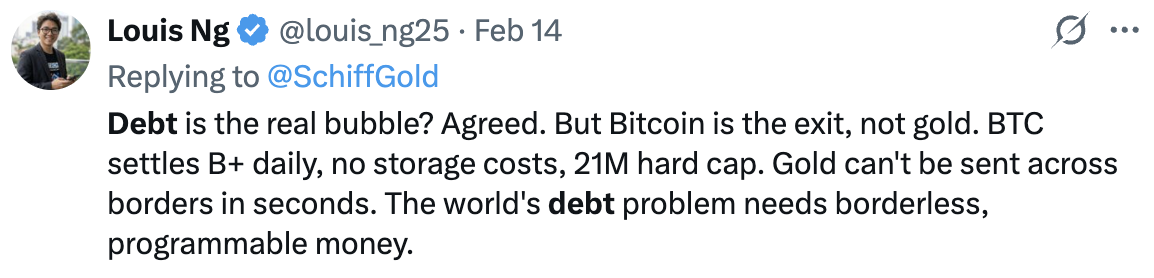
Schiff’s Bigger Warning: “Debt Is the Real Bubble”
Schiff’s recent comments are part of a broader macroeconomic argument. He warns that:
- U.S. government deficits are unsustainable.
- The Federal Reserve’s dovish policy fuels inflation.
- Housing costs remain elevated.
- Debt, not crypto, is the true bubble.
In this framework, Bitcoin is not seen as a solution to monetary instability. Instead, gold is positioned as the preferred hedge against economic uncertainty. Schiff recently claimed that gold is back above $5,000, suggesting that this level could be the new floor for the precious metal.
Whether one agrees with his pricing outlook or not, the message is clear: he views gold as structurally undervalued relative to global debt expansion. To Schiff, Bitcoin rallies are speculative waves, while gold rallies reflect deeper monetary realities.
Is Schiff Softening on Crypto?
On the surface, Schiff remains deeply critical of Bitcoin’s long-term viability. He continues to describe it as lacking intrinsic value and failing as a true inflation hedge. However, several subtle shifts suggest a more nuanced stance:
- He openly encourages Bitcoin holders to transact.
- His business actively integrates crypto payments.
- He acknowledges Bitcoin’s liquidity and demand.
These positions indicate that while Schiff may not believe in Bitcoin as money, he recognizes it as an asset class with buyers. That’s different from outright dismissal.
In earlier years, Schiff often framed Bitcoin as destined for collapse. Today, his tone appears more tactical. Rather than predicting imminent failure, he positions it as an asset to trade, then exit. This shift could reflect:
- Greater institutional adoption.
- ETF approval and mainstream access.
- Bitcoin’s survival across multiple market cycles.
Even critics adjust when markets mature.
Gold vs. Bitcoin: The Core Debate
At the heart of Schiff’s critique is a philosophical divide between traditional and digital assets. Gold supporters argue:
- Gold has thousands of years of monetary history.
- It is physically scarce.
- It has industrial and jewelry demand.
- It cannot be digitally hacked.
Bitcoin supporters, on the other hand, highlight:
- Bitcoin has provable digital scarcity (21 million cap).
- It is portable and divisible.
- It is censorship-resistant.
- It operates outside traditional financial systems.
Schiff prioritizes historical precedent and tangible assets. Bitcoin advocates prioritize programmability and decentralization. The debate isn’t just about price; it’s about the nature of money.
What Happens If Bitcoin Price Keeps Climbing?
If Bitcoin moves decisively above $70,000, Schiff’s “sell” call may be tested again. Historically, Bitcoin has experienced:
- Dramatic rallies.
- Severe drawdowns.
- Recovery cycles.
Gold, by contrast, tends to move more gradually. For investors, the choice often depends on:
- Risk tolerance.
- Time horizon.
- Belief in digital scarcity.
- Views on central bank policy.
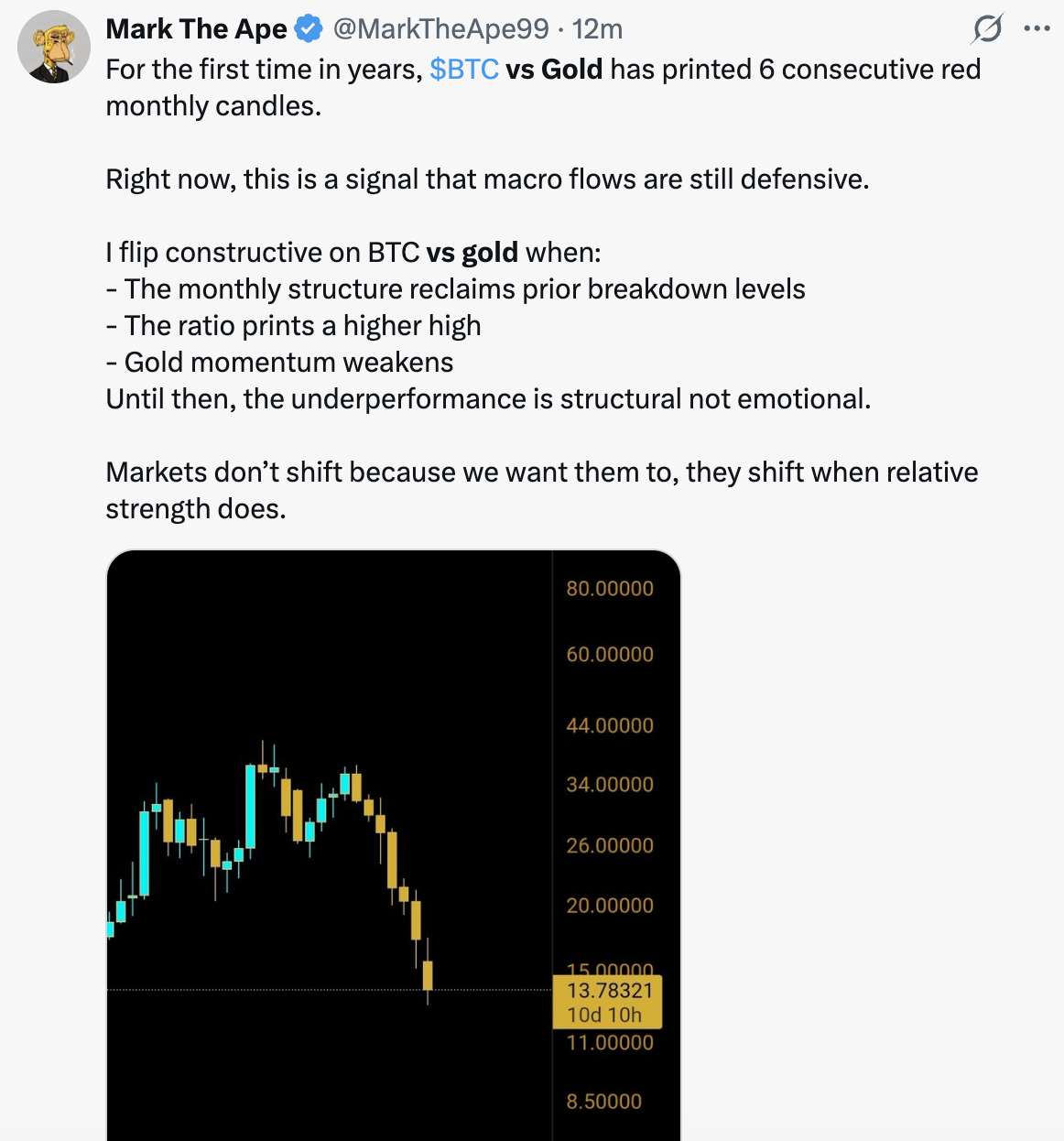
Schiff’s strategy reflects capital preservation. Bitcoin investors often seek asymmetric upside.
Can Both Gold and Bitcoin Co-exist?
An important point often overlooked in this debate: Gold and Bitcoin are not mutually exclusive. Some institutional investors now allocate to both:
- Gold for macro stability.
- Bitcoin for growth exposure.
Even some former Bitcoin critics now acknowledge that digital assets may function as “digital gold” in certain scenarios, though Schiff himself rejects that comparison.
But the existence of crypto payment rails at Schiff Gold highlights a broader reality: financial ecosystems adapt. It’s not necessary to believe in Bitcoin’s long-term dominance to monetize its current popularity.
Bitcoin’s Growing Acceptance in Traditional Finance
Perhaps the most interesting development isn’t Schiff’s price call. It’s the quiet normalization of Bitcoin in traditional businesses, even those run by skeptics.
A decade ago, a gold dealer publicly integrating crypto payments would have seemed contradictory. Today, it’s pragmatic.
Schiff may not be warming up to crypto philosophically. But he is operating within a financial world where crypto is too large to ignore. And that, in itself, says something about Bitcoin’s staying power.
Final Thoughts
Peter Schiff’s latest message is consistent with his worldview: Sell Bitcoin near $70,000. Buy gold near $5,000. Prepare for a debt-driven reckoning.
But beneath the rhetoric lies a subtle evolution. Bitcoin is no longer dismissed as fringe. It is treated as liquid capital. It is integrated into mainstream commerce. And it is acknowledged, even by critics, as financially relevant.
Whether Bitcoin ultimately outperforms gold or not remains to be seen. But the fact that one of its most persistent critics now actively facilitates crypto transactions, even indirectly, highlights a broader truth: in modern markets, skepticism and participation are no longer mutually exclusive.