

Key Takeaways
Advances in quantum technology could theoretically break Bitcoin’s current cryptography, exposing vulnerable wallets, especially older or dormant ones. Most developers believe there is still time to prepare before quantum computers become powerful enough to threaten Bitcoin’s security. Recent progress, including BIP-360, lays the groundwork for quantum-resistant output types, signaling proactive yet cautious development. Bitcoin Core developers prioritize conservative, security-focused upgrades, while institutional holders may demand faster action to mitigate perceived risks.
Bitcoin was designed to be decentralized, leaderless, and resistant to capture. No government controls it. No corporation owns it. Its development is open-source, volunteer-driven, and guided by rough consensus rather than executive mandate. But what happens when some of the largest asset managers in the world accumulate meaningful stakes in the network and begin to worry that its core cryptography may one day be broken?
That is the tension venture capitalist Nic Carter recently highlighted on the Bits + Bips podcast. His warning was stark: if Bitcoin developers fail to move quickly enough to address potential quantum computing threats, large institutional holders, including BlackRock, could attempt to assert influence over the protocol’s direction.
Carter is co-founder of Castle Island Ventures, a venture capital firm focused on public blockchain companies and a partner and co-founder of Coin Metrics, a crypto data and analytics firm. At the heart of this debate lies a complex question: Can institutions with fiduciary duties to shareholders pressure a decentralized network into upgrading faster than its volunteer developers deem prudent? And more provocatively: Could BlackRock “take over” Bitcoin?
Institutional Bitcoin Era: BlackRock’s iShares Bitcoin Trust and BTC Supply Concentration
BlackRock’s iShares Bitcoin Trust (IBIT) now holds approximately 3.8% of Bitcoin’s total supply. That makes it one of the largest known holders of BTC globally. To put this into context:
Bitcoin has a hard cap of 21 million coins. Roughly 19.7 million have been mined. A significant percentage is believed to be lost. Around 25% of the supply is considered dormant, unmoved for many years. When a single financial institution controls millions of coins on behalf of investors, it introduces a new dynamic into Bitcoin’s governance environment.
Bitcoin doesn’t have shareholders. It has node operators, miners, developers, and users. But large capital allocators bring something powerful: influence. And influence becomes particularly relevant when risk emerges.
Quantum Computing Threat to Bitcoin: How ECDSA and Shor’s Algorithm Could Break Cryptography
Bitcoin’s security relies on public-key cryptography, specifically elliptic-curve cryptography (ECDSA and, increasingly, Schnorr signatures). When a Bitcoin wallet is generated, it also brings:
A private key (secret).
A public key (derived from the private key).
A Bitcoin address (derived from the public key).
As long as the private key remains secret, funds are secure. But quantum computers, in theory, could change this. Shor’s algorithm demonstrates that a sufficiently powerful quantum computer could efficiently solve problems that are infeasible for classical computers, including the discrete logarithm problem underpinning Bitcoin’s cryptography.
In practical terms, a large-scale quantum computer could:
– Derive a private key from a public key.
– Potentially steal funds from exposed wallets.
– Dormant wallets are a particular concern. Many early Bitcoin addresses have exposed public keys, meaning that if quantum computing advances sufficiently, those coins could become vulnerable.
Roughly 25% of Bitcoin’s supply is believed to be dormant. If a quantum breakthrough allowed attackers to sweep these wallets, the economic shock would be significant.
Bitcoin vs Gold: Has Quantum Risk Impacted Long-Term Valuation Trends?
Some market observers argue the quantum debate may already be affecting Bitcoin’s valuation narrative. For more than a decade, Bitcoin steadily strengthened relative to gold, reinforcing the “digital gold” thesis. That long-term trend suggested Bitcoin should be valued significantly higher compared to the precious metal.
But critics claim that the trend has recently broken down and that awareness of quantum risk may be part of the reason. 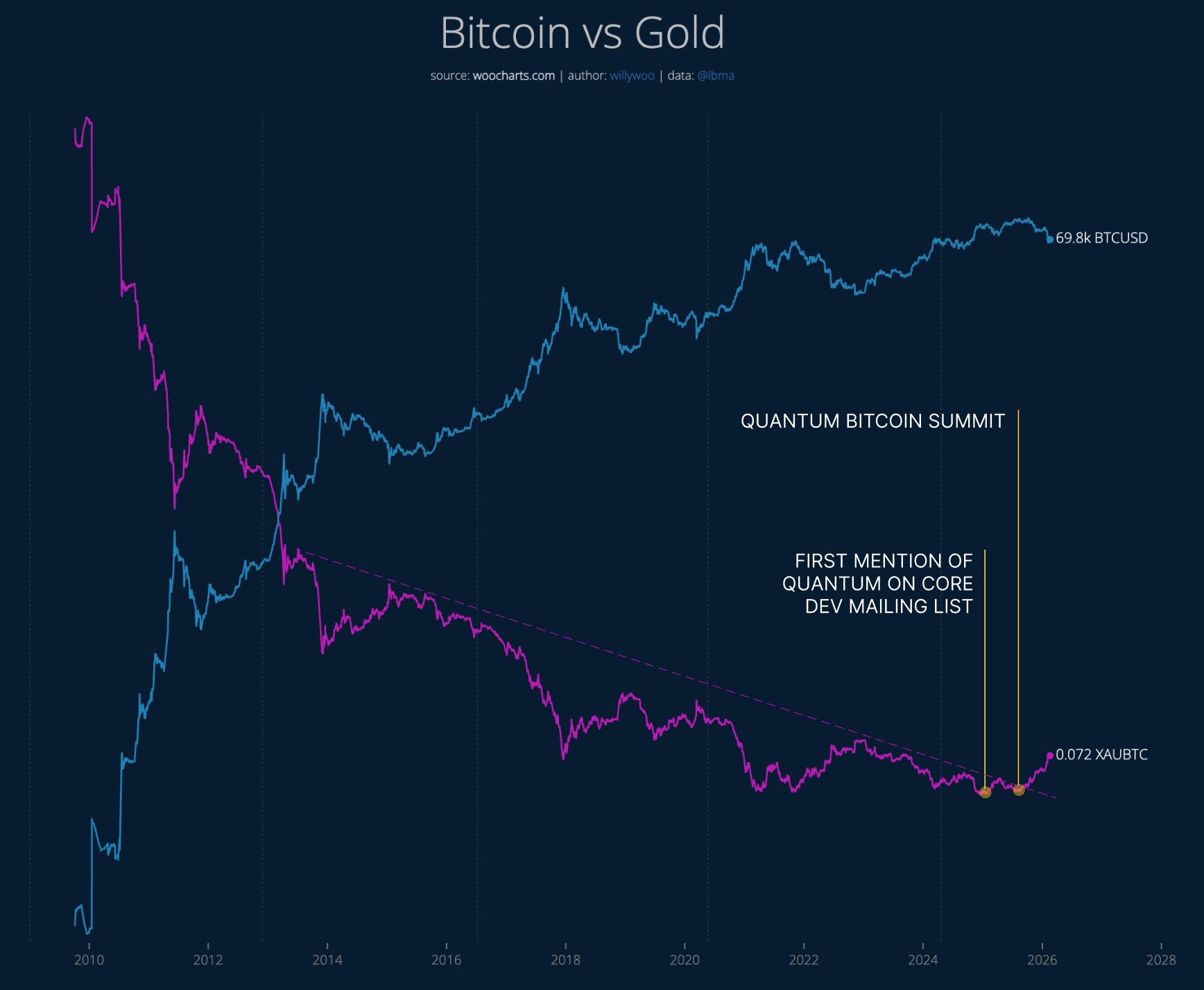 According to this view, once the possibility of quantum attacks entered mainstream discourse, investors began pricing in tail risk. The argument goes further: Bitcoin should trade at a much stronger premium to gold, but lingering uncertainty around cryptographic longevity is suppressing that valuation.
Whether this interpretation is correct remains debated. Bitcoin’s price dynamics are influenced by macro conditions, liquidity cycles, regulatory developments, ETF flows, and geopolitical factors. Still, perception matters in markets. Even theoretical risks can alter sentiment. The quantum discussion, therefore, is not just technical: it is psychological.
BIP-360 and Bitcoin’s Post-Quantum Upgrade Path
Developers are not ignoring the issue. On Feb. 11, BIP-360 was merged, adding a new output type designed to support future post-quantum signature schemes. This does not make Bitcoin quantum-proof today. Rather, it establishes infrastructure that could allow smoother migration if needed.
Bitcoin development is intentionally conservative: Changes undergo extensive peer review. Backward compatibility is prioritized. Security tradeoffs are debated rigorously. Many core contributors argue that there is still time before quantum machines pose an existential threat and that rushing could introduce greater risks.
Can Institutional Investors like BlackRock Influence Bitcoin Core Developers?
Nic Carter’s warning centers less on the cryptography itself and more on governance dynamics. Bitcoin Core developers are independent contributors. They are not employees of BlackRock or ETF issuers. But institutions have fiduciary duties. If they believe material risk is being ignored, they may not remain passive.
Carter suggests that if developers “do nothing,” major holders could attempt to influence direction, perhaps by funding alternative development teams, backing different client implementations, or advocating publicly for accelerated upgrades. This would not be a corporate takeover in the traditional sense. Bitcoin has no CEO. But capital can shape ecosystems.
Epstein’s Hidden Role in Early Bitcoin Developer Funding
Any discussion of influence over Bitcoin development inevitably recalls the controversy surrounding Jeffrey Epstein’s financial involvement in early crypto research circles. With the release of Epstein File documents, it was revealed that Epstein had donated to institutions connected to Bitcoin research, including the MIT Media Lab’s Digital Currency Initiative (DCI), which has supported Bitcoin Core contributors. Some developer salaries were indirectly funded through these donations, sparking backlash across the community.
It’s important to clarify that Epstein did not control Bitcoin Core, direct protocol decisions, or influence network governance. His involvement was limited to financial contributions that supported research and development activities. Still, the episode raised broader concerns about how open-source Bitcoin development is funded. Core contributors are typically supported by a mix of nonprofits, academic institutions, grants, and private companies. While this decentralized funding model reduces the risk of centralized control, it can also create reputational and transparency challenges.
For critics worried about institutional capture, the controversy highlighted how capital can enter the ecosystem without formal authority. For defenders, it reinforced a key principle: funding does not equal governance. Protocol changes still require broad technical consensus and network adoption.
BIP-110, Ordinals, and Bitcoin Governance Conflicts
Governance tensions are not limited to quantum risk. Another recent flashpoint involves Bitcoin Improvement Proposal 110 (BIP-110), aimed at reducing so-called Ordinals-like “spam” on the network. The proposal, introduced by pseudonymous developer Dathon Ohm in December, seeks to temporarily shrink the amount of data allowed in transactions. Its goal is to reduce images, videos, audio, and other non-monetary data being inscribed onto the blockchain.
Nearly 7.5% of Bitcoin nodes, all running the Bitcoin Knots client, have signaled readiness for BIP-110. Blockstream CEO Adam Back has strongly opposed the proposal. While acknowledging that Bitcoin should function as “sound money,” Back warned that implementing BIP-110 at the consensus level could damage Bitcoin’s credibility as a neutral monetary network. 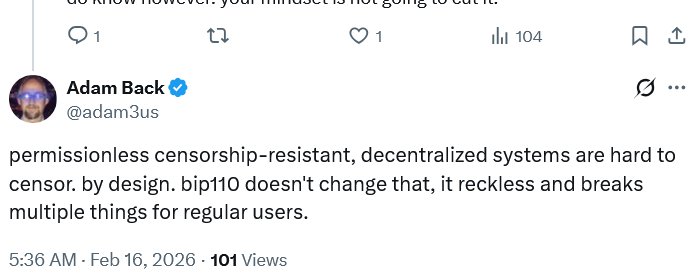
He described the effort as “a lynch mob attempt to push changes there is not consensus for,” arguing that spam is “just an annoyance” rather than a security threat. The Ordinals debate illustrates a broader theme: attempts to use consensus changes to enforce policy preferences can fracture social cohesion.
For institutions watching from the sidelines, repeated governance battles may raise concerns about stability.
Bitcoin Governance: Developer Caution vs Institutional Urgency
Bitcoin governance operates through:
- Node operators choose which software to run.
- Miners selecting blocks.
- Exchanges recognizing chains.
Any major change requires broad agreement. The blocksize wars of 2015-2017 demonstrated that economic weight alone cannot dictate protocol rules. Corporate-backed proposals were rejected when grassroots consensus failed to materialize. However, today’s environment is different. Institutional ownership via ETFs represents unprecedented capital concentration. If large holders coordinate around a specific roadmap, they could influence miners, infrastructure providers, and public discourse.
Still, unilateral control remains unlikely. Nodes ultimately determine which version of Bitcoin is recognized as legitimate.
Is the Quantum Threat to Bitcoin Overstated?
Several counterarguments temper the urgency narrative:
- Quantum computers capable of breaking Bitcoin do not yet exist.
- Scaling Shor’s algorithm to real-world attacks would require enormous fault-tolerant machines.
- Post-quantum migration can be implemented before catastrophic failure.
- Most funds remain protected until public keys are exposed.
- Developers emphasize that premature or poorly designed upgrades could introduce vulnerabilities worse than the threat itself.
In other words, caution is not complacency: it may be prudence.
Could BlackRock Take Over Bitcoin? Influence, Fragmentation, and the Future of BTC Governance
Could BlackRock “take over” Bitcoin? Not in a traditional sense. But influence is different from control. Large institutions can:
- Fund development
- Shape public narrative
- Advocate policy direction
- Pressure ecosystem actors
The greater risk may not be corporate domination, but fragmentation. If developers and capital holders diverge sharply on quantum preparedness, the result could be:
- Competing implementations
- Political infighting
- Potential chain splits
Bitcoin’s strength lies in social consensus. That consensus must balance technical rigor with economic reality.
Quantum Computing Is a Theoretical Risk, but Governance Debates Are Already Here
Nic Carter’s warning is not a prediction of imminent collapse. It is a reminder that Bitcoin’s evolution now unfolds in an institutional era. Quantum computing poses a theoretical threat. Developers are aware and taking incremental steps, including BIP-360.
Meanwhile, governance tensions, from quantum preparedness to Ordinals policy fights, reveal a network negotiating its identity. Is Bitcoin purely grassroots and developer-led? Or does capital inevitably gain influence as adoption scales? The answer may define the next decade.
Quantum computers may still be years away from posing an existential danger. But the governance debate about how to prepare, and who gets to decide, has already begun.